GPUs over time
Old gaming cards, newer consumer cards and data-center hardware: exploring GPU history without turning every comparison into a shopping list.
Archive 2026-10-17 · First published 2026-10-29
Loading content...

Old gaming cards, newer consumer cards and data-center hardware: exploring GPU history without turning every comparison into a shopping list.
I want to explore GPU history even where comparable AI measurements are missing. Memory capacity is one part of that history; it doesn't tell me how fast a model will run or what the whole setup will cost.
Retrospective archive placement: October 17, 2026. First published October 29. The graphic uses specifications captured October 17; its selected variants and source links were checked October 29.
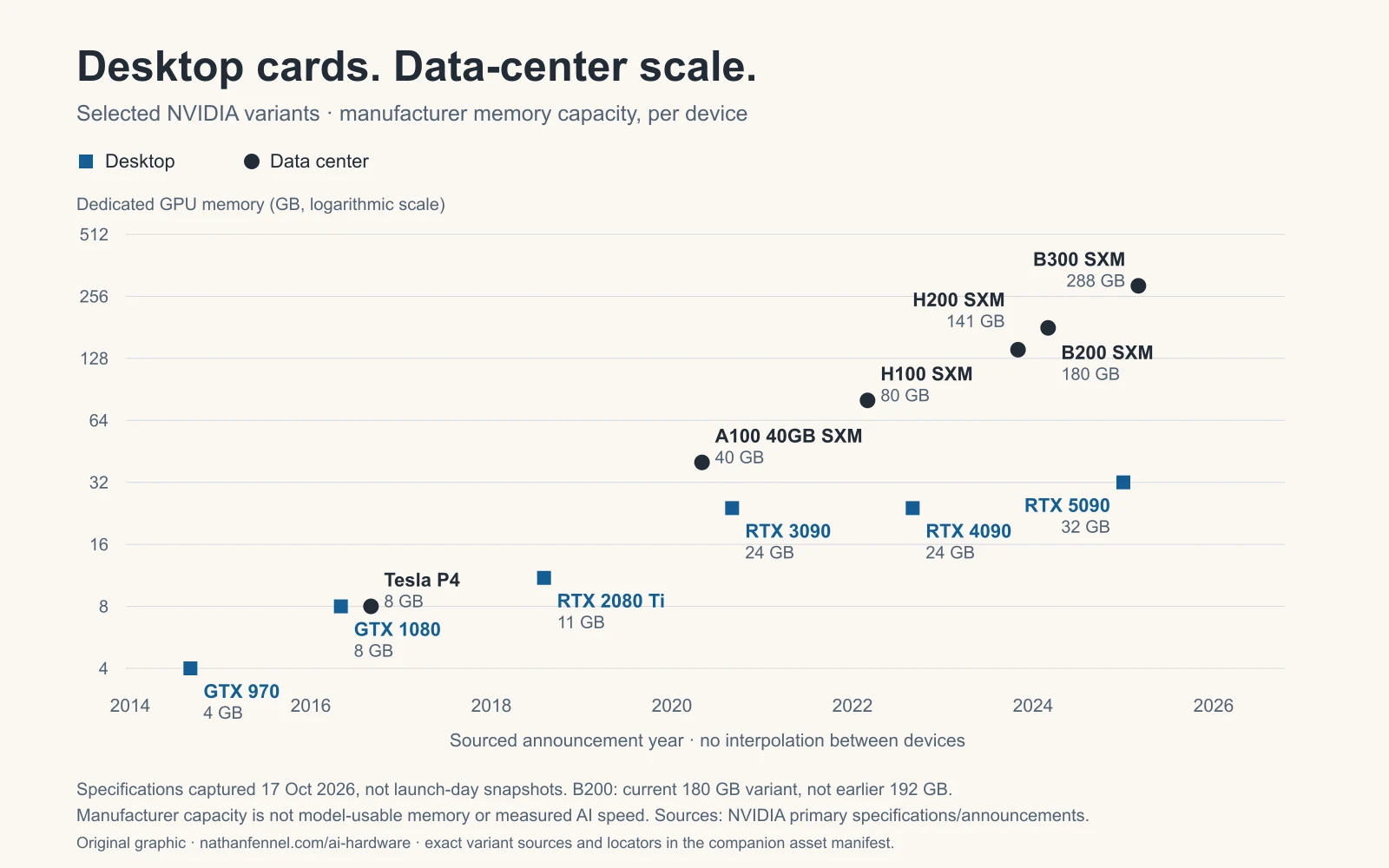
Selected manufacturer-rated dedicated-memory capacities plotted against announcement year. These are the specified variants, not necessarily their launch-day configurations or the memory available to a model. This is not an AI-speed ranking. Capacity sources: GTX 970, GTX 1080, GeForce RTX cards, Tesla P4, A100, H100, and H200, B200 and B300.
GPU history is fun to dig through. Old gaming cards, newer consumer cards, and data-center hardware that would be ridiculous to put in a house.
GTX 1080 Ti, RTX 3090, A100, H100, H200. What do all these names mean? What about X123? (I made that one up.)
Looking through GPU history and today's hardware puts those names in context. Memory, power requirements, software support, the work each generation could do. The interesting part is seeing how those pieces changed alongside each other, rather than treating every new card as the only one worth looking at.
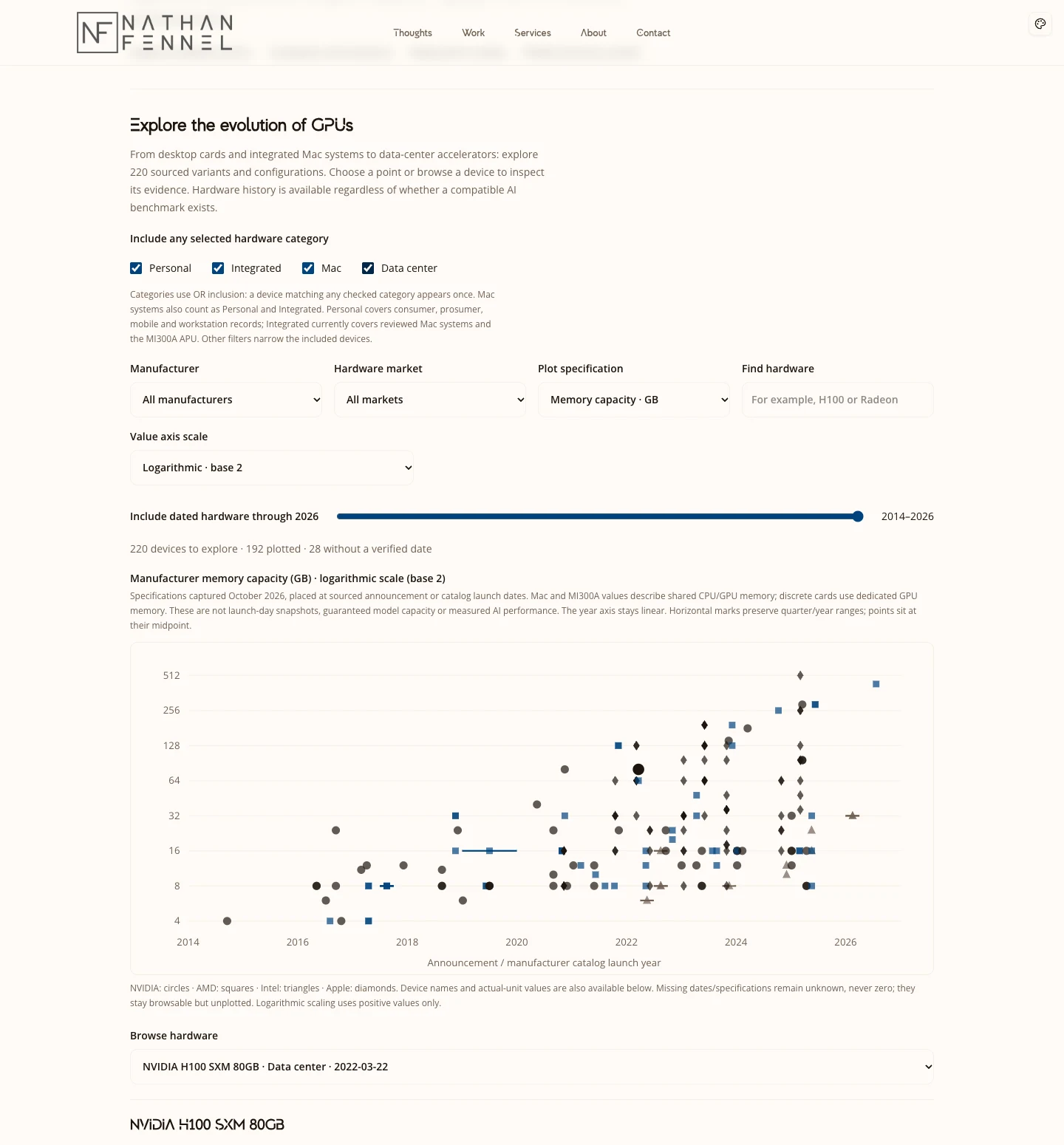
A local preview of the interactive GPU history page. The live explorer may include later changes.
The data-center hardware belongs in there too. It's part of the same history, even when the price, cooling, or infrastructure makes owning it completely unrealistic. A comparison can be interesting without turning into a shopping list. Sometimes it's just fun to look at how far the hardware has gone.
Owning one also has practical costs. A card's price leaves out the computer around it, electricity, and the time spent keeping everything working. Going into debt for a GPU doesn't make sense. Neither does buying hardware the rest of the setup can't support. Models change quickly; affordability and infrastructure are more useful places to start.
There's also more to usefulness than an immediate response. An older or modest card might be slow in a conversation but useful working through queued tasks overnight. More time can allow longer reasoning runs or additional review passes when the software supports them. Slowness doesn't improve the answers by itself. An overnight queue makes a longer wait less of a problem.
The speed comparisons need matched models and workloads. The history can be much broader, including hardware without comparable measurements. I don't want missing benchmarks to erase interesting parts of that history.