Matt Pocock's Skills, Three Months Later: Fork or Subscribe
Matt Pocock's skills repo grew from eleven guardrail files into a full engineering process: a native Claude Code plugin, a planning layer that lives on your issue tracker, and a public folder of deprecated ideas.
Matt Pocock's skills repo now ships as a native Claude Code plugin, and its new wayfinder skill parks the agent's plan on your issue tracker instead of in the context window. My April install is already a stale fork, which is exactly the tradeoff the plugin exists to fix.
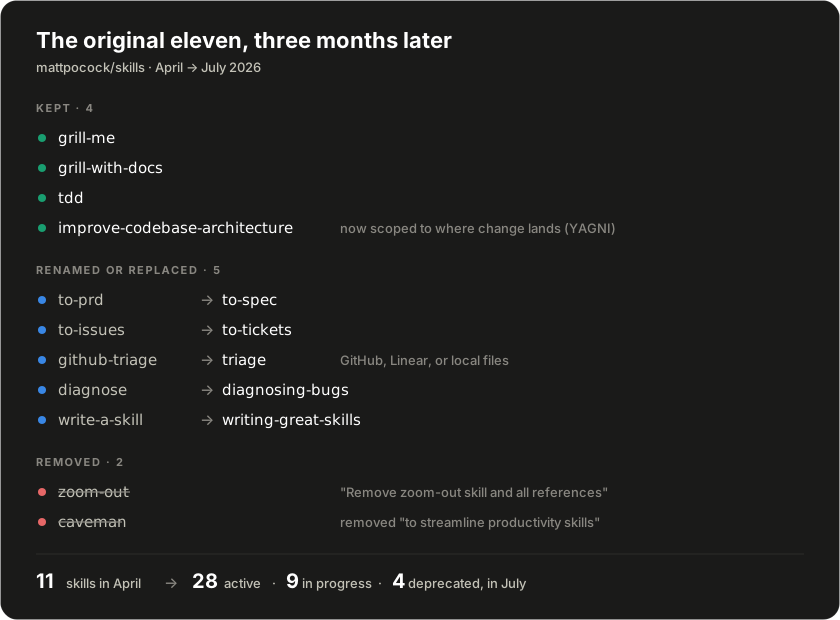
In April I wrote about installing Matt Pocock's eleven Claude Code skills as guardrails for agents that code faster than they think. Three months later, my global install still answers to /to-prd, /to-issues, and /github-triage. The repo has moved on: those are now /to-spec, /to-tickets, and a tracker-agnostic /triage, /diagnose became /diagnosing-bugs, and a couple of the originals, /caveman and /zoom-out among them, aren't in the tree at all anymore. The eleven files I copied are now twenty-eight active skills, nine more marked in-progress, and four sitting in a public deprecated folder.
I'm running a fork I never meant to create.
Four kept, five renamed, two deleted.
Fork or subscribe
That accident is now a first-class choice. The README offers two installs with two philosophies. The skills.sh installer copies the files into your project so you can hack on them and make them your own. The new Claude Code plugin installs the whole set as a read-only managed bundle that updates when he ships.
I defaulted into the fork without deciding to. A fork you're actively editing is the right call, and Matt says so himself: hack on them, make them your own. A fork you're merely sitting on is the worst of both, no customization and no updates. That second one is where I found myself this week, four renames behind.
The plan moves out of the context window
The new skill worth your attention is wayfinder. It takes work too big for one agent session and charts it as a map of "decision tickets" on your issue tracker (GitHub, Linear, or plain local files), then resolves them one at a time until the route is clear. Each ticket resolves a decision, not a slice of a build. Research subagents burn the open questions down, and the map issue indexes what's been decided.
The April skills disciplined a single session: interview me first, write the failing test first, debug in a loop. Wayfinder gives up on the session as the unit of work entirely. The plan lives on the tracker, any future session can pick it up, and the context window stops being the source of truth.
I've been arguing the small version of this for a while: hand the agent files about you and your task instead of re-explaining yourself every session. Wayfinder is the same idea pointed the other direction. Context files carry knowledge into a session. Decision tickets carry decisions out of one.
A process with a changelog
The repo also grew a setup wizard. /setup-matt-pocock-skills asks which issue tracker you use, what labels you apply at triage, and where docs should land, so the other skills stop guessing. Every skill now carries Codex metadata too, with a native Codex plugin on the roadmap.
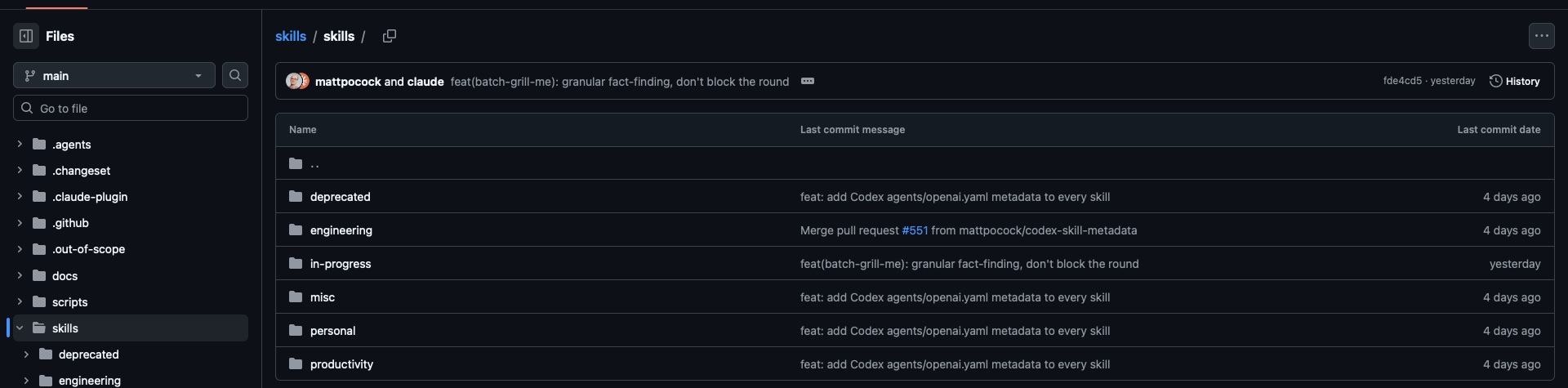
The skills tree today. Note the commit byline: "mattpocock and claude."
The detail I keep coming back to, though, is the folder structure. There's an in-progress bucket where half-formed skills develop in public (a batch-grill-me landed there yesterday) and a deprecated bucket where dead ideas stay visible instead of vanishing. He's versioning his engineering process the way the rest of us version code, complete with ADRs explaining why the plugin exists. Most prompt collections are a gist someone stopped updating. This one has a changelog, and reading the renames teaches you as much as reading the skills.
Either way, run /setup-matt-pocock-skills once per repo so the skills know your tracker and labels.
Three months ago the pitch was guardrails. Now it's a process you can subscribe to. Pick fork or subscribe on purpose this time; drifting into a stale fork, like I did, is the one option with nothing going for it.