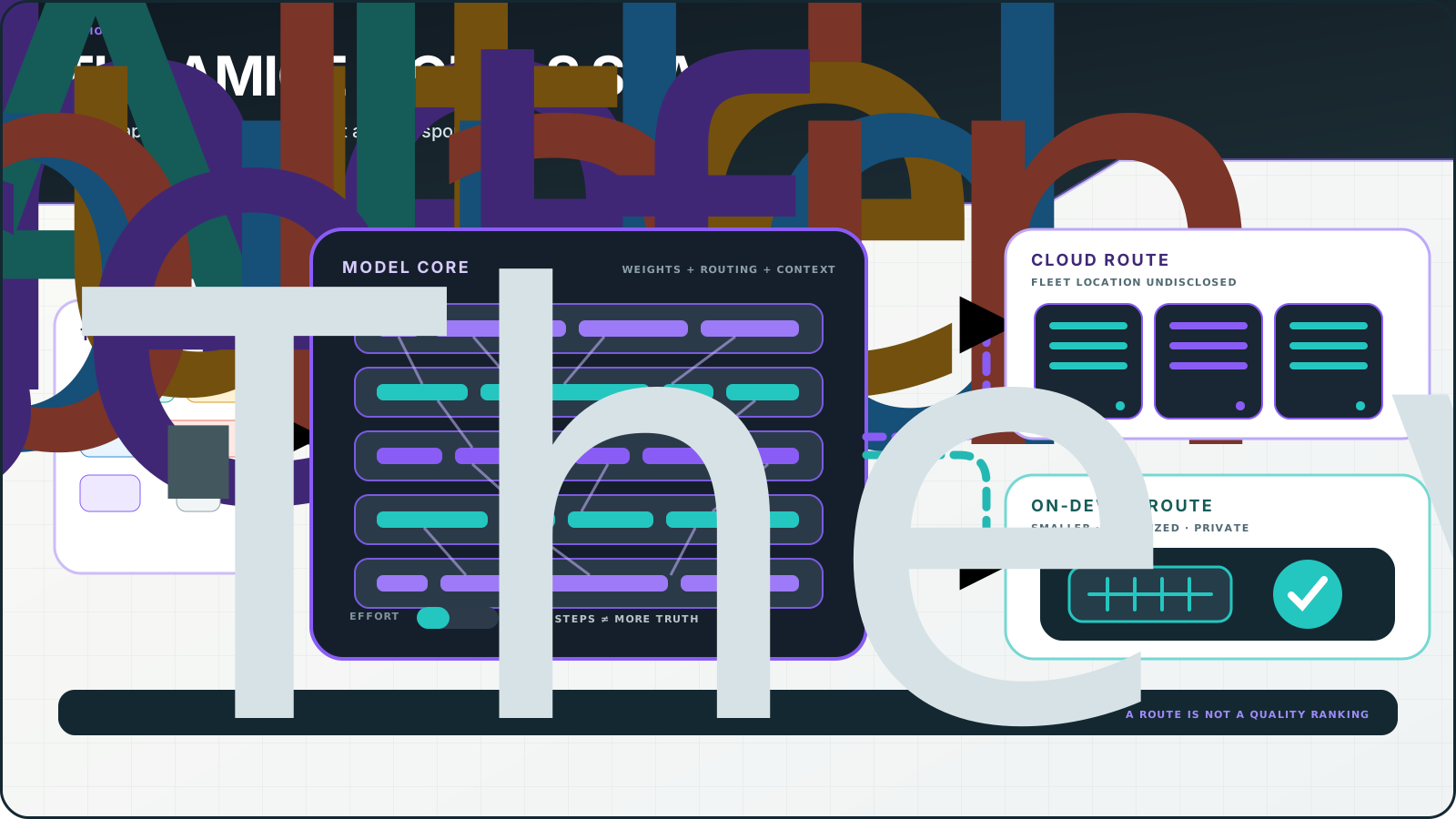
The AMICE models stack between prompt and response
An interactive field guide to model size, tokens, memory, speed, reasoning effort, open weights, deployment, routing, and the physical cost of an AI answer.
Choosing a model also means choosing a memory budget, a wait, and the hardware that will run it. I want to know what I'm getting beyond the product name.
We use the word model for almost everything between a text box and an answer. I find that confusing because those parts can change independently.
ChatGPT and Claude are products. GPT-5.6 and Claude 5 are model families. A dated API identifier can point to a checkpoint. "High effort" is a serving instruction. Fable and Mythos can wrap the same underlying model in different access and safety policies. A router can send two apparently identical product requests down different paths.
Those distinctions determine who controls the system, what it costs, where it can run, what an outsider can inspect, and whether comparing two environmental figures is even meaningful.
01B or T learned values
Parameters
Answers: The number of learned numerical values stored by a disclosed checkpoint.
Does not answer: Intelligence, active compute, training quality, memory precision, or serving speed.
02values used per token
Active parameters
Answers: For a sparse model, the approximate subset routed into computation for one token.
Does not answer: Total weights that must be stored, moved, sharded, or licensed.
03input + output tokens
Context window
Answers: The advertised maximum sequence budget under specified conditions.
Does not answer: Reliable recall, usable document length, KV-cache footprint, or answer quality.
04milliseconds or seconds
Time to first token
Answers: Queueing plus prompt ingestion and other work before streaming begins.
Does not answer: The speed of the remaining response.
05tokens per second
Output speed
Answers: Decode speed under a stated tokenizer, hardware, load, precision, and serving path.
Does not answer: Prompt-processing speed, task completion, aggregate throughput, or cross-tokenizer reading speed.
06total tokens/s or requests/s
System throughput
Answers: The total work a serving system completes across concurrent users.
Does not answer: The streaming speed experienced by one user.
The interactive catalog retains its September 4, 2026 research snapshot. The prose and further reading were reviewed on September 17, 2026; individual records keep their own source dates. Model catalogs move fast, so every current claim carries a date and every absent disclosure stays absent. A missing hardware disclosure should sit beside any documented training systems and serving deployments. Those records can answer different parts of the question.
Begin with a token
Large language models do not read and write words in the way people do. A tokenizer divides text into pieces, maps those pieces to numbers, and the model repeatedly estimates a distribution for what token should come next. The 2017 Transformer paper introduced the attention-centered architecture behind that loop; current systems add years of changes in data, scale, multimodality, sparse routing, training, tools, and serving.
Token boundaries depend on the tokenizer and language. A short English word may be one token; an unfamiliar name, emoji, line of code, or word in another language may split differently. With these varying token boundaries, a million-token context window is not a million words, and output tokens per second are not automatically comparable across model families.
One decoding loop
A language model writes one model-specific token at a time
Move through a simplified generation cycle. This is an architectural teaching view—not a trace of hidden reasoning, a provider tokenizer, or one production request.
The model predicts the next token.
Illustrative token pieces
Token 1: "The"
Token 2: " model"
Token 3: " predicts"
Token 4: " the"
Token 5: " next"
Token 6: " token"
Token 7: "."
These hand-authored pieces explain the concept. They are not output from OpenAI, Anthropic, Google, Apple, or another production tokenizer.
Step 1 of 5
Tokenize
A tokenizer turns text into model-specific integer pieces. Another model can split the same characters differently.
Schematic activity · not neurons, parameters, or compute utilization
There are two distinct phases when a hosted language model answers. Prefill processes the input and constructs working state for the sequence. Decode produces output one token at a time. A long document can therefore make the first token slow even when the answer streams quickly once it begins.
The product may also retrieve documents, call a search service, inspect an image, run code, invoke a safety classifier, or ask another model for help. The clean mental model is not "prompt → model." It is:
product experience = router + model or models + context + tools + policy systems + serving hardware
Training changes weights; inference uses them
Pretraining adjusts a model's parameters across many examples. The amount and quality of training data matter alongside parameter count. DeepMind's 2022 Chinchilla study tested that tradeoff under a fixed compute budget: its 70-billion-parameter model, trained on more tokens, outperformed the much larger Gopher on the evaluations reported. That is evidence about a training recipe and benchmark set, not a rule that smaller always wins.
Post-training shapes a pretrained model for use. The InstructGPT paper describes supervised learning from demonstrations followed by reinforcement learning from human preferences. Modern systems use different combinations of methods; this paper explains one influential approach, not every provider's current recipe.
Ordinary inference uses the resulting weights to process your context. Adding a document to a chat changes the information available for that answer; it does not, by itself, retrain the checkpoint. The provider's policy separately determines retention and later use for training. A larger context window and a newly trained model are different ways to change what a system can do.
Published training and serving systems
The documentation review added September 18 separates a model's training run from its later serving deployments. It includes original technical reports, provider engineering accounts, and cloud documentation. Choose a provider to compare the claims without turning a training cluster into an inference route.
Documented hardware and regions
204 additional sources reviewed September 18, 2026. Each record names the workload or geography it supports. Training records describe training; availability and development plans have their own labels.
Your location can suggest a region to research. Endpoint configuration, residency rules, capacity, and cross-region routing determine where a request can run. Nearby data centers are not evidence of your application's serving location.
50 of 204 sources · showing 1-20
Research documentation
Documented AI hardware, training, cloud regions, and regional electricity
An Anthropic performance engineer recalls securing TPU and GPU clusters in November 2023 while preparing Claude Opus 3, with a large Trainium cluster still forthcoming.
The retrospective establishes cluster families and timing, but does not identify precise chip generations or the complete Opus 3 training allocation.
AWS publishes an Anthropic compute leader's statement describing almost one million Trainium2 chips training and serving Claude, with further Trainium3 use anticipated.
The customer statement does not split training from inference capacity or identify the chip and region for an individual request.
documented
Publication date unavailable Reviewed 2026-09-18 primary
DeepSeek-V3 was trained on 2,048 NVIDIA H800 GPUs. The report accounts for 2.788 million H800 GPU-hours across pretraining, context extension, and post-training.
Reported run costs exclude earlier research and ablations; training hardware does not establish the current API route.
Gemma 3 training used TPU v5e for 1B and 4B, TPU v4 for 12B, and TPU v5p for 27B, with chip counts listed by model.
The table describes training infrastructure, not an automatic mapping from model name to inference hardware.
historical
Published 2025-03-25 Reviewed 2026-09-18 academic
Page 1 of 3
Model size depends on the job
There is no standards body assigning every model to small, medium, or frontier. "Lightweight" usually means designed around a constraint: memory, power, latency, price, or a device's thermal envelope. The result might be genuinely small, distilled from a larger teacher, quantized to fewer bits, sparsely activated, specialized for one task, or several of those at once.
"Frontier" is relative. It usually describes the most broadly capable systems near the current capability boundary, not a fixed parameter threshold. Even regulation uses its own definitions for its own purposes; a legal training-compute threshold is not a consumer buying guide.
A smaller system can outperform a larger one on the task it was trained for. OpenAI's InstructGPT research found its 1.3-billion-parameter instruction-tuned model was preferred to 175-billion-parameter GPT-3 on the prompts studied. That did not make the smaller model universally more capable. It showed why parameter count is not a scoreboard.
The model-size decoder
Lightweight and frontier are bundles of tradeoffs—not parameter thresholds
Compare disclosed architectures. Total parameters affect stored weights; an active-parameter figure uses the publisher’s stated routing scope, which can be per token or per request. Neither number is a universal intelligence score.
Select a disclosed model
Alibaba / Qwen · mixture of experts
Qwen3 30B-A3B
10% active share shown
Weights to store
30B total
Displayed active figure
3B active
Read the publisher wording below for its routing scope; “active” is not universally a per-token measurement.
Precision disclosure
30B total, 3B activated per token.
Deployment boundary
Total weights still need storage even though per-token compute routes through a subset.
Other constraints on model size: modality, context, precision, memory, latency target, batching, software, device envelope, training, and the job. Equal active-parameter counts do not imply equal operations, memory traffic, quality, or latency. A quantized large model can fit locally; a small multimodal model can still be computationally demanding.
Total parameters approximate the learned values that must be stored. They do not tell you how many participate in each token.
Active parameters matter for sparse models, where a router selects only part of the network. Keep the unit attached to the disclosure. Most cited MoE counts are per token, while Apple describes AFM3 Core Advanced as selecting 1-4B parameters per request.
Precision changes weight memory. Four-bit storage is not the same footprint as sixteen-bit storage.
Context creates a separate and growing working-memory burden.
Reasoning effort can increase inference-time work without changing the checkpoint at all.
In a dense model, almost all major weight blocks participate for each token. In a conventional token-routed mixture-of-experts model, a learned router chooses a subset of expert blocks for each token; other sparse designs can route at the prompt or request level. "Expert" is a mathematical name; it does not mean one little neurologist and one little tax lawyer live inside the network. Sparse activation can reduce arithmetic while the full collection of weights still has to live somewhere across memory and machines.
Who actually makes a model?
The field is wider than the three names in a typical consumer model picker. OpenAI, Anthropic, Google DeepMind, xAI, Meta, Apple, Amazon, Microsoft, Mistral, Alibaba's Qwen team, DeepSeek, Moonshot AI, Cohere, and NVIDIA all publish or operate consequential model families. Their roles differ.
A company can research and train a model, publish its weights, operate an API, distribute it through a cloud marketplace, wrap it in an app, or license it to someone else. Those are separate relationships. Google can design TPUs, operate data centers, train Gemini, and ship the Gemini app. Apple can design models and silicon, run local inference, operate Private Cloud Compute software, and still use outside cloud and model technology for other routes. A startup can build a product around several outside models without training a frontier checkpoint.
Model makers
A cloud catalog is not an authorship list
Search companies that design or train model families. A distributor, cloud, application, chip supplier, and model maker can be different organizations—or several roles inside one vertically integrated company.
Showing 14 of 14 reviewed makers.
OpenAI
United States
US
Proprietary general-purpose, reasoning, coding, image, and realtime families.
first party appapimanaged clouddownloadable weights
Boundary: Qwen3.8-27B uses Apache 2.0 while the 2.4T-A95B and Flash-Next checkpoints use custom Qwen licenses, so artifact and license status must be checked per checkpoint.
Reasoning and general-purpose sparse models with downloadable weights and API service.
Named families
DeepSeek V4 Pro · DeepSeek V4 Flash
textdevice actions
first party appapidownloadable weights
Boundary: Weight licensing, hosted checkpoints, aliases, and API routing are separate; running the weights yourself does not reproduce the hosted service.
The atlas shows public model makers without pretending their disclosure practices are equal. A service-only model can publish prices and context while withholding parameter count. A downloadable model can expose weights while withholding the training corpus. A company can disclose a cloud portfolio without revealing which provider served your request.
Reporting needs to keep these roles separate too. "Available through AWS" is not evidence that AWS trained the model. "Runs on NVIDIA" is not evidence for a specific GPU, site, batch, or user request. "Owned by Google" is not evidence that every Google AI feature calls Gemini.
Downloadable weights and open-source requirements
The phrase open model is so overloaded that it is nearly useless without an artifact list.
The Open Source Initiative's Open Source AI Definition requires the freedoms to use, study, modify, and share an AI system, along with access to parameters, code, and sufficiently detailed data information in the preferred form for modification. Downloadable weights alone do not establish all of that.
The openness ledger
Downloadable weights are not automatically open-source AI
Inspect an abbreviated artifact view and the license for a named release. “Open,” “open source,” “open model,” and “open-weight” are not interchangeable labels.
Open-weight under a custom license
Meta Llama 4
Model weights
published
Inference code
published
Training code
partial
Training-data information
partial
Evaluations
published
License
Llama 4 Community License
Restrictions and boundary
Custom acceptable-use and large-platform provisions; inspect the exact license.
Abbreviated artifact view: this matrix does not inventory tokenizers, data-processing code, intermediate checkpoints, documentation, or every downstream right and restriction. The Open Source Initiative definition asks whether people can use, study, modify, and share the system with model parameters, code, and sufficient data information. This lab records publisher artifacts; it is not individualized legal advice.
evaluation artifacts and intermediate checkpoints;
rights to modify, redistribute, and use derivatives commercially;
field-of-use, scale, or acceptable-use restrictions.
Meta's Llama weights, for example, are downloadable under a custom community license. Mistral 3 and Qwen3 publish model weights under Apache 2.0, while DeepSeek has released selected weights under MIT terms. Those facts are valuable, but a license on tensors does not magically reveal the full dataset or reproduce the training run. The interface therefore uses service-only, open-weight, and cautious artifact-by-artifact labels instead of one green "open source" badge or a legal compliance verdict.
How much hardware does it take?
I can't estimate hardware from a model name alone.
A useful lower bound for raw weight storage is:
parameters × bits per parameter ÷ 8
At sixteen bits, eight billion parameters occupy about 14.9 GiB before runtime overhead. Seventy billion occupy about 130.4 GiB. At four bits, the same raw floors are roughly 3.7 GiB and 32.6 GiB. Those examples use binary gibibytes; the interactive lab displays decimal gigabytes, so its number is slightly larger for the same bytes. None of those numbers means "this model will run on this GPU."
The fit calculator
Stored weights are the beginning of the memory bill
Calculate a raw weight floor, then add a user-selected KV-cache assumption. The sum is a known arithmetic floor—not a complete memory estimate, supported deployment, speed forecast, or hardware recommendation.
Decimal GB means 10⁹ bytes here, not GiB (2³⁰ bytes). The marker only divides a known floor by advertised capacity; it is not a feasible hardware count.
This does not prove the model runs. It omits architecture-specific KV dimensions, activations, workspaces, runtime, fragmentation, adapters, multimodal towers, communication buffers, redundancy, usable versus advertised memory, bandwidth, interconnect, supported kernels, and quality at the chosen precision. Active MoE weights are not the amount that can be omitted from storage.
The raw weight floor already includes learned embedding weights when the published parameter total includes them. Real inference also needs quantization metadata, activations, temporary workspaces, serving software, and the KV cache: stored attention state for prior tokens. KV memory grows with context length, batch size, layer count, key/value heads, head dimension, and cache precision. Different architectures compress or share it differently.
The PagedAttention paper behind vLLM gives a concrete example. It treats KV-cache allocation as a memory-management problem, reducing fragmentation and allowing sharing within and across requests. Better serving software can therefore make the same hardware support more useful work without changing the model's parameter count.
The lab therefore reports raw capacity floors rather than a definitive GPU count. It lets you place those floors next to advertised memory capacities while leaving operational fit unresolved. The resulting container count only divides a known arithmetic floor by nominal capacity; it is not a feasible hardware count, and no universal overhead percentage covers every architecture and serving stack. A model that technically loads can still be unusably slow, starve its KV cache, exceed a device's power budget, or need an interconnect to span several accelerators.
CPUs remain excellent at flexible control flow and orchestration. GPUs dominate large-model training and much cloud inference because they combine massive parallel matrix throughput with high memory bandwidth. NPUs trade generality for power-conscious acceleration of supported neural operations, making them attractive inside phones and laptops. Most real systems use all three, plus storage, RAM, and network fabric.
Compare speed under the same conditions
A claim of 300 tokens per second needs more detail. Is that per user or across the system? Which hardware and tokenizer were used? How many requests ran at once? How long did the user wait for the first token?
The latency dashboard
Tokens per second describes only the streaming phase
Change four teaching assumptions. The arithmetic separates first-token delay, decode speed, end-to-end time, and aggregate load; it does not predict any named model or provider.
TTFT
1.2 s
Decode phase
6.4 s
Arithmetic total
7.6 s
Hypothetical aggregate
25 tok/s
Simple product, not measured throughput
Illustrative stream
A useful answer arrives after prompt ingestion, queueing, scheduling, and repeated decoding.
Schematic, capped visual word stream: these chunks are not real tokenizer output and their playback does not simulate the selected TTFT or TPS.
Not a benchmark: decode time is max(output tokens − 1, 0) ÷ TPS because TTFT already includes the first output token. The concurrency result is only a hypothetical multiplication, not measured aggregate throughput. Real concurrency changes queueing, batching, cache use, per-user speed, and hardware utilization. Cross-model TPS also depends on tokenizer, prompt/output length, precision, runtime, speculative decoding, network, and measurement percentile.
Time to first token (TTFT) includes queueing and prefill before streaming begins.
Inter-token latency (ITL) describes the gaps between streamed output tokens.
Per-user output speed is approximately the inverse of ITL.
Aggregate throughput counts work across all concurrent requests.
Under the common convention that TTFT ends when the first output token arrives, a response containing O output tokens takes approximately TTFT + (O - 1) × ITL. Counting O complete inter-token intervals adds one interval that did not occur.
Batching can improve fleet throughput while making one person wait longer. A very fast decoder can still lose a task by producing a needlessly long answer or requiring a retry. A speed number from one accelerator, quantization, prompt distribution, batch policy, and percentile cannot be transferred to a different deployment.
That is also why OpenAI's "up to 750 tokens per second" preview for GPT-5.6 Sol must stay attached to its limited Cerebras serving route, and Google's reported Flash-Lite speed must retain the benchmark source and conditions. They describe particular offerings. The same model can run at a different speed elsewhere.
Read the load curve before the headline speed
MLCommons' MLPerf Endpoints benchmark makes a useful tradeoff visible: adding simultaneous users can increase total throughput while reducing each user's response speed. Compare systems at a stated latency requirement and load, rather than picking the largest tokens-per-second number.
For a customer-support assistant, time to the first useful response may matter more than maximum fleet output. An overnight classification job can tolerate waiting if it finishes cheaply and meets its quality target. These are different service requirements even when they use the same model. Hardware benchmark results need their model, quality target, software configuration, and workload attached.
The family-name decoder
Provider naming combines several independent ideas: capability class, generation, modality, access policy, product plan, and sometimes a routing mode. The decoder lets you pull those labels apart.
Name versus identity
Family, generation, model, safeguard, and effort are different labels
Choose a maker and inspect dated records. Product menus compress several technical and commercial dimensions into short names.
Fable and Mythos are not two capability rungs. Anthropic says Fable 5 and Mythos 5 are configurations of the same underlying model; safeguards and trusted-access rules distinguish them.
fast / economical
Claude Haiku 4.5
available
High-volume, latency-sensitive work and subagents.
Access: Claude products, API, AWS, Google Cloud, and Microsoft Foundry; surface availability varies.
$1/M input · $5/M output
Identity boundary: A model class and pinned checkpoint, not a guarantee of hardware, location, energy, or water use.
Legacy Mythos-class model superseded by Fable 5.1 on September 1, 2026 but still available.
Access: Listed as a still-available legacy model on the Claude API, AWS, Google Cloud, and Microsoft Foundry after the Fable 5.1 launch; product-plan access varies.
$10/M input · $50/M output
Identity boundary: Same underlying model as Mythos 5; classifiers and fallbacks mean the selected Fable label need not prove which model handled every request.
Long-running agentic coding, knowledge work, and multistep research; successor to Fable 5.
Access: Claude API, Amazon Bedrock, Claude Platform on AWS, Google Cloud, and Microsoft Foundry; product-plan access varies. Retirement not sooner than September 1, 2027.
$10/M input · $50/M output
Identity boundary: Same underlying model as Mythos 5.1 with cybersecurity and biology safeguards; the $0.25/M cache-read price and always-on adaptive thinking are pricing and runtime facts, not evidence of a different set of weights.
Anthropic is the clearest 2026 case. Haiku, Sonnet, and Opus are recurring capability and price classes. The September 4 catalog snapshot lists Haiku 4.5, Sonnet 5, Opus 5, and Fable 5.1, consistent with the provider comparison checked on September 17. The original Fable 5 launch remains a useful historical example of a different distinction. Fable and Mythos are not two ordinary rungs above Opus. Anthropic says Fable 5 and restricted Mythos 5 use the same underlying Mythos-class model, capabilities, specifications, and pricing. The difference is the surrounding safeguards and who may access the less-restricted configuration.
Fable's classifiers can decline or reroute some sensitive-domain requests to Opus. Mythos is limited to vetted cyber-infrastructure and selected scientific programs. Changing the safety configuration and access contract can create a different service even when the underlying model is the same. The public description does not establish that every surrounding classifier or policy component lives inside identical weight files.
OpenAI's Sol, Terra, and Luna are separate GPT-5.6 models aimed at frontier, balanced, and high-volume work. Selecting "high" effort on Sol does not turn it into another checkpoint. Google's Flash-Lite and Flash names describe service classes, but they do not disclose parameter sizes or guarantee a particular TPU. xAI's Grok product includes distinct language, image/video, and voice services rather than one endpoint that does everything.
Why can't every model be available all the time?
Even a released checkpoint is not an infinite utility. Capacity has to be reserved, regions and cloud marketplaces have to deploy it, safety and legal reviews differ by surface, and product plans ration expensive serving routes.
The availability gate
A model can exist without being available to you
Capacity, safety, product packaging, tool fit, lifecycle, and governance create different catalogs. Select a gate to see what it controls—and what it does not prove.
Selected gate
Capacity and economics
A premium model can consume more expensive serving capacity, longer reasoning time, or scarce launch supply, so subscriptions and APIs meter it differently.
Dated example
Fable 5 moved between included access and usage credits while Anthropic expanded capacity.
Limits of this evidence: that the public explanation reveals every internal capacity pool, fallback, classifier, region, checkpoint, or commercial decision.
product plan, enterprise agreement, geography, age, or account verification;
modality and tool support in a particular app;
capacity, rate limits, fallback behavior, and maintenance;
safety classifiers or a trusted-access program;
preview status, staged rollout, alias migration, or retirement;
device memory, operating-system version, language, and thermal state.
Fable 5 is a useful warning against treating a launch post as permanent state. Anthropic suspended and later redeployed capacity under changing access and credit rules. A page that does not preserve those dates turns an operational history into a contradiction.
Where does a model run?
Sometimes the answer is quite specific. Apple says its roughly three-billion-parameter 2025 on-device foundation model used aggressive quantization and memory techniques. Apple's 2026 AFM3 family separates a dense 3B on-device Core model, a sparse 20B Core Advanced model that activates 1-4B parameters depending on the request, and cloud models for harder work. Its Private Cloud Compute architecture is a privacy and service system, not merely the phone model moved into a server.
Model deployment
Deployment precision stops before the individual request
Filter disclosed device, cluster, portfolio, and customer-selected paths. A named cloud or campus still does not identify the server, accelerator, grid, or cooling system used by one answer.
provider portfolio · training and inference
OpenAI serving portfolio
allocation unknown
Operators
Microsoft Azure · Oracle / Stargate · AWS · CoreWeave
↓
Hardware boundary
Mixed and not request-disclosed
↓
Individual request
Not publicly allocated
Azure is primary while OpenAI documents additional contracted capacity across other providers.
A partnership or campus announcement cannot locate a GPT-5.6 request or identify its chip.
For hosted frontier models, public evidence is usually a portfolio rather than a GPS trace. Anthropic names AWS as its primary cloud and also documents Google TPU, Microsoft/NVIDIA, and xAI capacity relationships. OpenAI names Azure as primary alongside Oracle/Stargate, AWS, and CoreWeave capacity. Google describes Gemini running across its own TPU infrastructure. None of those facts locates an individual prompt.
The map therefore does not drop a fake pin on "the Claude data center." It shows the disclosed level of precision: device, provider portfolio, distributed cluster, or unknown. A cloud contract is not a workload allocation; a campus announcement is not proof that the model you selected ran there.
Apple Intelligence can run on-device because the local models and features are designed around Apple's hardware, memory, power, and product constraints. Harder or broader tasks can cross into Private Cloud Compute or a separately disclosed external service. The fact that one local feature works without a warehouse of GPUs does not imply the same device can train or even serve the largest general-purpose model.
What does "reasoning effort" actually change?
It does not turn on more neurons. It is a provider-specific control over how much inference-time deliberation, checking, tool behavior, or hidden reasoning work the service may spend. The exact implementation is usually private and can change by model version.
Checkpoint versus effort
More reasoning effort changes the work budget—not the model’s identity
Pair an illustrative task with an effort setting. The bars show relative teaching levels only; they do not predict hidden tokens, quality, latency, price, or energy for a provider.
Illustrative inference-time budget
Medium
relative level 2/4
Routine work with several constraints or modest tool use.
Model checkpoint
Defines the released model identity, weights, architecture, and capability envelope—even when much of that remains undisclosed.
Effort or thinking setting
Lets an eligible checkpoint spend a different inference-time budget or use a different runtime policy. Vendor implementations differ.
For “Summarize several documents”: The suggested medium starting point is a teaching heuristic. Escalate after a failed evaluation, not because the longest setting feels safest.
Higher effort can be useful when a task genuinely benefits from decomposition, verification, or search. It can be wasteful on extraction, formatting, classification, or an email you will immediately edit. It usually raises latency and cost; it can also overthink an easy request. For expensive mistakes, independent evidence, domain evaluation, and accountable human review provide checks an effort slider cannot.
The labels are not portable. OpenAI's low, medium, and high do not establish the same budget as xAI's similarly named settings or Anthropic's adaptive thinking. Output verbosity is separate again. A concise answer can involve substantial internal work, while a long answer can come from a low-effort route.
The right question is not "Which setting is smartest?" It is "What is the cheapest, fastest route that clears the quality and risk threshold for this task?"
Does Haiku use less water than GPT-5.6 Sol?
Even if one route used less arithmetic under tightly matched conditions, that would not establish a measured water ratio. No public dataset lets us hold task, success rate, tokens, effort, cache, batching, hardware, location, weather, cooling system, and accounting boundary constant between those two services.
Energy and water
A smaller model may use less compute—but the public record cannot meter this comparison
Use the evidence checklist for the same-task Haiku-versus-GPT-5.6 Sol question. Checking every field designs a study; it does not manufacture a result.
Haiku versus GPT-5.6 Sol
No defensible energy or water ratio
5 required boundaries are still missing. Public model names and API prices cannot fill them.
company estimated
Median Gemini Apps text prompt
0.24 Wh · 0.03 gCO₂e · 0.26 mL onsite freshwater
Scope: Point-in-time May 2025 median under Google’s stated serving boundary and 2024 fleet-average factors.
Excludes: Training, external networks, end-user devices, data storage, request-level location, indirect electricity-generation water, and embodied hardware water.
A fleet prompt estimate, an executive average, and a national data-center model have incompatible scopes. Do not rank models by placing these three numbers in one chart.
The evidence cards deliberately refuse to calculate the comparison. Google reported that a median Gemini Apps text prompt in May 2025 used 0.24 Wh and 0.26 mL of onsite freshwater under its stated fleet boundary. Sam Altman separately wrote that an average ChatGPT query used 0.34 Wh and about 0.32 mL of water, but supplied no comparable methodology. Those values differ in model mix, time, boundary, and transparency. They are not a Gemini-versus-ChatGPT benchmark.
The Lawrence Berkeley National Laboratory's U.S. data-center report estimated 66 billion liters of direct water consumption and nearly 800 billion liters of indirect power-sector water consumption for all U.S. data centers in 2023. Dividing those totals by a guessed number of AI prompts would manufacture precision.
For one completed task, impact can change with retries, hidden reasoning, output length, router fan-out, tool calls, cache hits, utilization, accelerator efficiency, facility PUE, cooling WUE, and the grid. On-device inference may avoid data-center cooling for that request, but it still uses device electricity and hardware with a manufacturing footprint.
The impact lab is therefore a study-boundary checklist, not a model leaderboard or calculator. It shows what a matched comparison would have to measure and keeps fleet estimates, executive claims, and national data-center totals visibly separate; checking every box still does not produce an energy or water result.
Put the right model on the right job
Using the most expensive model for every task is not the same as using AI responsibly. It can increase delay, cost, and resource use without improving the result.
Minimum sufficient model
Route by constraints, then escalate on evidence
Choose four requirements. The result recommends a model class and escalation policy—not a brand, benchmark winner, or guarantee of quality, cost, privacy, or environmental impact.
Suggested starting class
Start with a balanced general-purpose model
This is a reasonable default when privacy, modality, and latency do not force a narrower choice.
Orthogonal oversight requirement
Define the human-review boundary
Name when a person must verify, approve, override, or stop the workflow. A model recommendation never assigns accountability.
Escalation rule
Escalate for a documented failure mode; downgrade after the task becomes repeatable.
1 · DefineSet a quality, latency, privacy, and cost threshold.
2 · EvaluateTest representative work, including failure cases.
3 · EscalateSpend more only on the step that misses the threshold.
This teaching router contains no live prices, private prompts, automated provider calls, or claim that a smaller model always uses less energy.
The teaching router starts with the task rather than a brand:
Use a small or local route for reversible, low-stakes classification, extraction, rewriting, and private device actions when it meets the quality bar.
Escalate for ambiguity, long-horizon planning, difficult coding, cross-source synthesis, multimodal work, or repeated verification failures.
Increase effort when evaluation shows the task benefits from more checking.
Preserve a human and an evidence trail for medical, legal, financial, security, or other high-impact decisions. A frontier label is not oversight.
This is a teaching heuristic, not a reconstruction of any provider's proprietary router. Its real lesson is that good routing requires evaluation. Teams should test representative tasks, define the failure cost, record latency and price, and promote a request only when the smaller route misses the target.
A reporter's lead desk
The most revealing fields are often the empty ones. Which checkpoint does a consumer alias actually reference? What fraction of requests hits each router branch? Which support models and tools fan out behind one answer? What precision and hardware serve each tier? How often does a safety classifier substitute another model? Which regions host the service, and what are their measured PUE and WUE?
Reporter mode
The undisclosed router is often the real story
Model names, prices, defaults, access rules, and serving routes change quickly. This frozen edition preserves the disclosure date and leaves parameters, hardware, locations, and request allocation unknown when providers do not publish them. Research frozen Sep 4, 2026.
12 reporting leads
01
For each product mode, what exact checkpoint or router served the request, and when did that mapping change?
02
What share of requests are automatically escalated, downgraded, refused, or routed to a fallback model?
03
Which plan, geography, cloud, safety class, capacity pool, and feature gates each model?
04
Are “fast,” “balanced,” and “frontier” separate checkpoints, quantizations, serving tiers, or inference-time settings?
05
For sparse models, what are total parameters, active parameters per token, expert count, routing policy, and deployed precision?
06
What are p50 and p99 TTFT, inter-token latency, output TPS per user, total system TPS, input/output lengths, concurrency, hardware, runtime, and date?
07
How much memory goes to weights, KV cache, activations/workspace, runtime, batching, and fault-tolerance reserve?
08
Which training-data information, code, checkpoints, optimizer state, evaluations, and license terms are actually available?
09
Which named clouds, clusters, accelerator families, and regions train and serve each model—and what allocation remains undisclosed?
10
What is the measured energy and water boundary for a model class: prompt, completed task, tool-using workflow, tenant, region, or fleet?
11
When a safeguard triggers, is the request refused, rewritten, monitored, or served by another model—and is the user told?
12
How often would a right-sized smaller model complete the same evaluated task with acceptable quality, latency, and expert oversight?
The downloadable ledger behind this page keeps those unknowns intact. They are reporting leads, not defects to paper over. Product makers could make the model layer far more legible by publishing alias histories, routing shares, per-tier latency distributions, hardware and region ranges, matched energy and water boundaries, and licenses expressed as artifact matrices rather than one "open" adjective.
Choosing a model for a real task
If you retain six ideas, keep these:
A product is a routed system, not a model name.
Parameters, active parameters, context, effort, and speed answer different questions.
Downloadable weights are not automatically open-source AI.
A hardware estimate without precision, context, batching, and runtime assumptions is incomplete.
Cloud partnerships reveal portfolios, not the location of your prompt.
No public evidence supports a precise Haiku-versus-Sol water ratio today.
The model layer feels intangible because its useful objects are software and numbers. But every choice in it changes the infrastructure below: memory moved, accelerators occupied, networks crossed, heat rejected, and capacity reserved. Understanding those choices is how the AMICE stack stops being a five-layer diagram and becomes a system you can interrogate.
Sources worth opening
These reading notes were checked on September 17, 2026. The interactive source ledgers retain their separately dated records.
MLCommons: MLPerf Endpoints. Compare user latency and total throughput under load. A system benchmark is not a universal model speed.
Kwon and colleagues: PagedAttention. A systems paper showing why KV-cache allocation affects serving throughput. Its measured speedups belong to its tested workloads and baselines.
NVIDIA: GPU performance background. An engineering explanation of compute, bandwidth, and latency limits. Its worked examples use specific older hardware.